






Virtual Security Officer Services

100% Certification Success Rate

100+ Companies Served

15+ Years of Experience
CBIZ Pivot Point Security’s Virtual Chief Information Security Officer (vCISO) and Virtual Security Team (VST) services provide organizations with the expertise, guidance, and operational support required to help keep critical data secure. Our team of experienced security professionals will work together with your organization to develop an information security strategy that aligns with your organization’s business strategy. Our services enable your information security, privacy, and AI programs to effectively manage risk, conform with client contractual and regulatory compliance obligations, and achieve your organizational goals. A well-defined strategy is critical as developing comprehensive Information security/privacy/AI programs can often be a multi-year effort, especially when formal attestation, certification, or authorization (e.g., ISO/IEC 27001, ISO/IEC 27701, ISO/IEC 42001, SOC 2, FedRAMP, HITRUST, CMMC) is required.
CBIZ Pivot Point Security delivers its vCISO/VST solutions in a virtualized security team model that provides access to a diverse pool of experts specializing in cloud security, threat intelligence, compliance, incident response, and more – all in a highly cost-effective and flexible manner. This model allows our clients to scale security resources on demand, tap into specialized knowledge across multiple domains, and leverage insights from hundreds of clients across dozens of industries.
Why Your Business Needs a Virtual Security Officer
Virtual Security Officer vs. Full-Time CISO vs. Contractor: What's the Difference?
Our Virtual CISO Consulting Services
How Our Virtual CISO Service Works
Benefits of Partnering With Our vCISO Services
Why Trust Us for vCISO Services?
Frequently Asked Questions (FAQs)
Secure Your Business Today With vCISO Services
Free Resources
CBIZ Pivot Point Security’s Virtual Chief Information Security Officer (vCISO) and Virtual Security Team (VST) services provide organizations with the expertise, guidance, and operational support required to help keep critical data secure. Our team of experienced security professionals will work together with your organization to develop an information security strategy that aligns with your organization’s business strategy. Our services enable your information security, privacy, and AI programs to effectively manage risk, conform with client contractual and regulatory compliance obligations, and achieve your organizational goals. A well-defined strategy is critical as developing comprehensive Information security/privacy/AI programs can often be a multi-year effort, especially when formal attestation, certification, or authorization (e.g., ISO/IEC 27001, ISO/IEC 27701, ISO/IEC 42001, SOC 2, FedRAMP, HITRUST, CMMC) is required.
CBIZ Pivot Point Security delivers its vCISO/VST solutions in a virtualized security team model that provides access to a diverse pool of experts specializing in cloud security, threat intelligence, compliance, incident response, and more – all in a highly cost-effective and flexible manner. This model allows our clients to scale security resources on demand, tap into specialized knowledge across multiple domains, and leverage insights from hundreds of clients across dozens of industries.
The benefits of partnering with a vCISO/VST include:
- Cost-effective security leadership: You gain access to experienced security professionals at a fraction of the cost. It helps you avoid the costs of hiring, onboarding, and retaining a full-time CISO and specialized security staff.
- Strategic risk management: With virtual CISO services, you get to effectively identify, assess, and mitigate cybersecurity risks. A vCISO will develop a bespoke security strategy aligned with your business objectives. You also get to leverage a Governance, Risk, and Compliance (GRC) platform for streamlined organizational workflows.
- Regulatory compliance support: vCISO/VST services help your organization align with regulations, standards, and frameworks like Payment Card Industry Data Security Standard (PCI DSS), General Data Protection Regulation (GDPR), Health Insurance Portability and Accountability Act (HIPAA), ISO/IEC 27001, and SOC 2. They help you stay ahead of evolving compliance requirements.
- Vendor risk management: Our VST can provide hands-on operational support to address resource-consuming responsibilities like Third Party Risk Management, Attack Surface Monitoring, and Security Questionnaire Response management.
- Incident response preparedness: Develop and test incident response plans to promptly detect and respond to security events before they escalate to business-impacting incidents.
| Feature | vCISO | Full-Time, In-House CISO | Independent Contractor |
| Cost | Predictable retainer or scope-based costs with no employee benefits and no payroll tax overhead | Fixed salary, plus potential bonuses, employee benefits, equity, and recruitment costs | Variable hourly rates or fixed project fees based on specific scopes of work |
| Expertise | Access to a broader team of specialists across diverse domains, such as privacy, cloud, AI, and compliance | Expertise is tied to the individual’s background | Generally engaged for targeted projects or niche requirements |
| Integration and ramp-up | Leverages established firm frameworks and methodologies to facilitate rapid onboarding and assessment | Requires standard executive recruiting, hiring timelines, and a traditional organizational ramp-up period | Depends on the contractor’s familiarity with your specific tech stack |
| Continuity | The firm retains institutional knowledge, helping maintain service continuity if an assigned consultant changes | Departures require a new executive search and transition period | Engagements end upon project completion, requiring deliberate knowledge transfer before departure |
| Scalability | Flexible resourcing allows the adjustment of support levels based on current business demands or audit cycles | Sudden spikes in workload may require hiring additional staff or outside help | Limited to the contractor’s personal bandwidth and contracted hours |
Our Virtual CISO Consulting Services
At CBIZ Pivot Point Security, we provide these vCISO/VST services:
We conduct comprehensive risk assessments to identify potential threats and vulnerabilities to your organization’s data and systems. We create a detailed security roadmap to address the identified risks. The aim is to create a long-term plan for how an organization will manage its cybersecurity risks, build stakeholder confidence, and align with business goals.
Our compliance and regulatory guidance helps organizations align with, or obtain certification to, regulatory and client-contractually obligated frameworks such as ISO 27001, GDPR, and NIST CSF. Once the scope and context have been clearly established, we will conduct a gap assessment against the relevant frameworks and build a gap remediation plan to execute. We also develop the necessary documentation and reports to demonstrate compliance and prepare for third-party assessments, helping save time, effort, and internal resources.
We use tools and processes to constantly monitor systems and networks for suspicious activity that could indicate an attack. We integrate threat intelligence into your organization’s broader cybersecurity strategy. This proactive approach involves gathering and analyzing the latest cyber threats and attack techniques to anticipate likely tactics and reduce the likelihood and impact of attacks.
This service involves developing security policies, procedures, and guidelines for your organization that align with recognized industry standards such as ISO/IEC 27001 and the NIST Cybersecurity Framework (CSF). We help your team create clear and comprehensive documentation defining critical security practices.
Your employees are often your first line of defense and your biggest risk. We go beyond policy to help you build a security-first culture with comprehensive security awareness training programs and controlled phishing simulations to educate your staff on social engineering tactics. This service enables your entire organization, from the receptionist to the C-suite executive to understand their role in protecting critical data.
While strategy is critical, technical execution is key. Our team supports your IT department in the practical application of security controls to design a resilient environment. We provide guidance on secure network architecture, cloud configuration (AWS, Azure, and GCP), and system hardening standards. Whether you are building from the ground up or remediating vulnerabilities, we align your technical environment with best practices like CIS Benchmarks and NIST guidelines.
We use the following approach when providing vCISO consulting solutions:
- Initial assessment: We understand your business, its objectives, and your current security posture. Through interviews and artifact review, we conduct a risk assessment to understand critical risks and a gap evaluation leveraging an open trusted framework.
- Strategic roadmap development: In this stage, we create a longer-term strategic plan and a near-term tactical plan to move the program forward in alignment with the business goals.
- Implementation and monitoring: This phase involves executing the tactical plan aligned with the strategic plan. Because the only constant is change, we continuously monitor and make adjustments as necessary.
- Regular reporting: We deliver transparent reports to stakeholders and leadership, keeping them informed about their security posture, progress, and any critical updates.
Benefits of Partnering With Our vCISO Solutions
When it comes to virtual CISO companies, CBIZ Pivot Point Security stands out for offering these advantages:
- Enhanced security posture: Build stronger defenses against evolving cyber threats to keep your organization secure.
- Reduced operational costs: Gain the security expertise you need at a fraction of the cost and pay only for the services you need.
- Flexible engagement models: Benefit from information security services that can scale as your business grows.
- Expert advisory access: Gain immediate access to experienced security professionals who can help your organization achieve its cybersecurity AND business goals.
- Improved customer trust: Build confidence in your security measures with clients and stakeholders, leveraging the value of open trusted frameworks and third-party attestation.
- Proactive compliance tracking: Know you are maximizing your ability to demonstrate compliance with relevant regulatory and client obligations and minimizing the risk of dealing with a breach.
Why Trust CBIZ Pivot Point Security for vCISO Services?
CBIZ Pivot Point Security is your dedicated partner for vCISO solutions. Our cybersecurity expertise, honed since 2001, focuses on ensuring solutions that both preserve and create business value. Our team has decades of combined experience and a proven track record guiding a wide range of clients through complex security challenges. We offer tailored solutions because we understand that every organization has unique needs. We also back our work with a 100% satisfaction guarantee. If our partnership doesn’t achieve your specific target outcomes, we will adjust the fee to make it right.
From risk assessments and cybersecurity strategy development to security governance and compliance, we offer comprehensive support. We focus on ensuring the security solutions we provide align with your business goals. Our proactive approach anticipates emerging threats, and our transparent collaboration keeps you informed. You can count on us to offer services that build a resilient security posture that withstands changing threats and boosts stakeholder confidence.
Virtual CISO FAQs
A Virtual CISO is a fractional model that provides your organization with top-tier cybersecurity leadership. It helps organizations strategize, plan, and implement comprehensive cybersecurity, privacy, and AI risk management programs
The services of a vCISO help bridge the gap between technical teams and executive leadership, integrating seamlessly with in-house teams. Our domain expertise is often complemented by industry-specific expertise in sectors such as SaaS, not-for-profit, financial services, and health care.
Costs vary based on scope, most notably how many VST services that are consumed. We have engagements ranging from $4K to $30K+ per month, with most falling towards the lower end of that range.
Organizations in highly regulated sectors like healthcare, finance, AI, legal, and technology benefit most due to their complex needs regarding sensitive data, compliance, and privacy.
A vCISO offers a scalable team of experts for a fraction of the cost, while a full-time CISO relies on a single individual’s expertise and availability. A VST provides a far greater level of resilience from potential employee turnover.
Our experts collaborate directly with your internal staff to align security initiatives with business goals and integrate strong cybersecurity, privacy, and AI governance practices into your existing operations and culture.
Secure Your Business Today With vCISO Services
Ready to enhance your cybersecurity posture with expert guidance? Contact us today to learn how our vCISO consulting services can protect your organization and support your compliance needs.
Free Resources

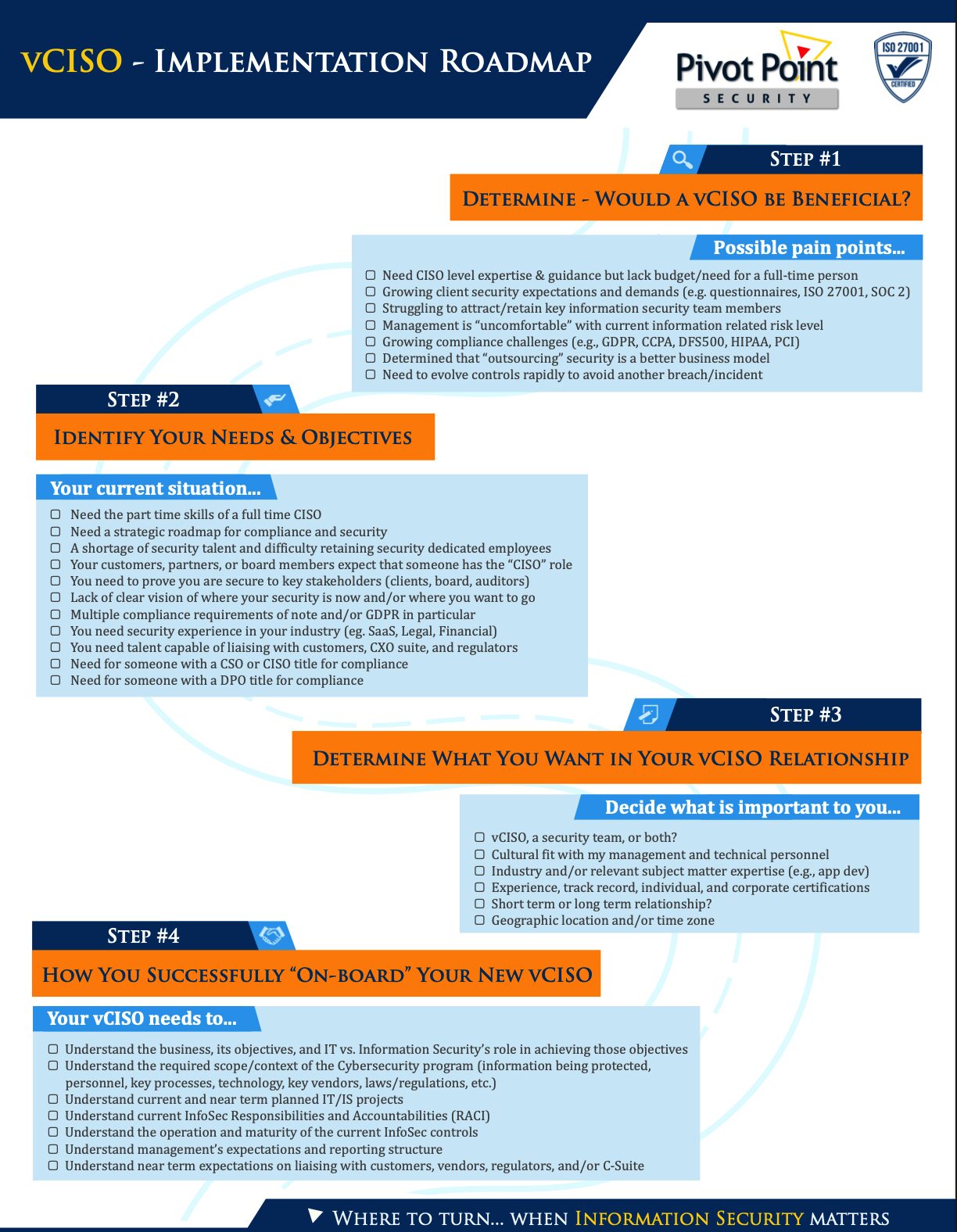
Download the vCISO Implementation Roadmap
Get the Guide
Access our vCISO Roles & Responsibilities Worksheet.
Download the Free InfographicAccess Your vCISO Implementation Roadmap



Featured Resources